Behavior as a Science: ABA All Around Us – Motivating Operations

Behavior as a Science: ABA All Around Us – Motivating Operations
The principles of Applied Behavior Analysis do not just occur within the vacuum of a clinical or

therapeutic setting. Believe it or not, we see the fundamentals of ABA constantly in our daily

lives. For this “ABA All Around Us” series, we’re going to break down some basic concepts and

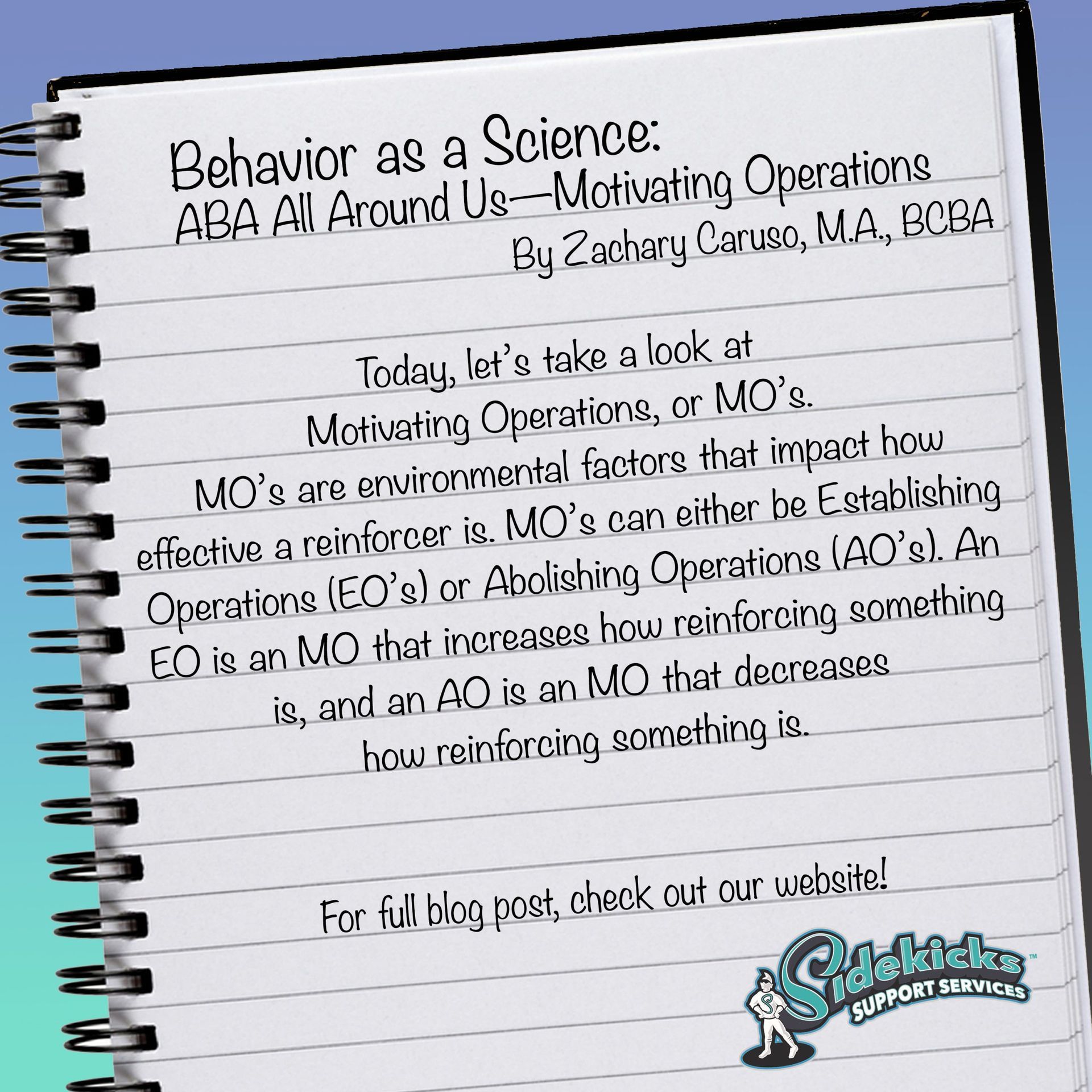
apply them to real-world situations. Today, let’s take a look at Motivating Operations, or MO’s.


MO’s are environmental factors that impact how effective a reinforcer is. MO’s can either be Establishing Operations (EO’s) or Abolishing Operations (AO’s). An EO is an MO that increases how reinforcing something is, and an AO is an MO that decreases how reinforcing something is. MO’s precede SD’s in the behavior contingency. Remember, as we discussed last time, an SD is an environmental stimulus that signals to an individual that reinforcement is available contingent upon the occurrence of a specific behavioral response.


Let’s apply the concept of MOs to a real-world scenario. You’re going for a walk in the park on a hot summer day. You begin to get thirsty and see a water fountain on the side of your walking path up ahead. You stop at the fountain for a drink and then you continue walking. In the previous blog, we talked about Three-Term Contingencies; however, the above scenario is an example of a Four-Term Contingency.


Four-Term Contingencies include the MO as the first step in the contingency. In the above example, the setting event of you going for a walk on a hot summer day is the EO that increases how reinforcing water is (Step 1). The sight of the fountain up ahead is the SD which signals that water is available, as long as you engage in the behavior of stopping to take a drink (Step 2). Taking a drink at the fountain is the behavior (Step 3), and finally, gaining access to water and having your thirst quenched is the reinforcer (Step 4). Let’s try another example. One of your favorite drinks is hot chocolate; however, on a hot summer day you probably won’t be reinforced by gaining access to hot chocolate. This is because there is an abolishing operation (AO) in effect which decreases the reinforcing effectiveness of hot chocolate at that moment.

By Sidekicks Support Services May 5, 2026
Daily living assistance in Lawrence, NJ supports adults with new diagnoses of intellectual and developmental disabilities, promoting independence through personalized in-home services.
By Sidekicks Support Services May 5, 2026
Functional Communication Training in West Windsor, NJ teaches children with autism and developmental disabilities effective communication strategies to reduce challenging behaviors and improve social interactions.
By Sidekicks Support Services May 5, 2026
Community integration support in Trenton, NJ teaches individuals with developmental disabilities skills for navigating public spaces, social interactions, and accessing community resources throughout New Jersey.
By Tara Folmer BCBA April 21, 2026
Meltdowns can feel overwhelming for both children and parents. One minute, everything is fine, and the next, your child is crying, yelling, or completely shutting down . It’s easy to think: “They’re being defiant.” “They need consequences.” But the truth is… meltdowns are not misbehavior. They are a signal. What Is a Meltdown? A meltdown happens when a child becomes so overwhelmed that they lose the ability to cope. This can look like: Crying or screaming Dropping to the floor Refusing to move Hitting or throwing items Shutting down completely At this point, your child is not choosing this behavior; they are struggling to regulate their body and emotions. Why Do Children Have Meltdowns? Meltdowns don’t come “out of nowhere.” There is always a reason, even if it’s not obvious in the moment. 1. Difficulty Communicating Some children don’t yet have the skills to say: “I need help.” “This is too hard.” “I want a break.” So instead, their behavior does the talking. 2. Transitions and Changes Many children struggle when: Leaving a preferred activity Switching tasks Plans change unexpectedly Even small transitions can feel like a big loss of control. 3. Sensory Overload Environments that feel typical to us can be overwhelming to a child: Loud noises Bright lights Busy spaces Their nervous system becomes overloaded. 4. Difficulty Waiting or Delayed Gratification Waiting is a skill, and for some children, it’s a very hard one. 5. Fatigue, Hunger, or Illness Sometimes the cause is simple: Tired Hungry Not feeling well These are often called “setting events,” and they make meltdowns more likely. Why Punishment Doesn’t Work: When a child is in a meltdown, their brain is in survival mode. They are not able to: Process consequences Learn from the situation “Think through” their behavior Punishment in this moment often: Escalates the meltdown Damages trust Doesn’t teach the child what to do instead What to Do Instead: 1. Stay Calm (Even When It’s Hard) Your calm helps regulate your child. Think of it as: “I’m lending them my calm until they can find their own.” 2. Reduce Language During a meltdown, less is more. Instead of long explanations, try: “I’m here.” “You’re safe.” “Let’s take a break.” 3. Give Space (When Safe) Some children need space to regulate. Stay nearby, but don’t overwhelm them with demands or questions. 4. Support Regulation Help their body calm down: Deep breaths (if they can tolerate it) Quiet space Comfort item Sitting together quietly 5. Teach Skills After the Meltdown This is the most important part. Once your child is calm, you can teach: How to ask for help How to request a break How to wait How to handle “no” This is where real learning happens. Rethinking Our Approach to Meltdowns: The goal is to: ✔ Understand why they’re happening ✔ Teach replacement skills ✔ Reduce them over time A Different Way to Look at Behavior: Instead of asking: “How do I stop this behavior?” Try asking: “What is my child trying to communicate?” Key Takeaways: Meltdowns are hard, but they are also opportunities. They tell us: What skills a child is missing What support they need Where we can help them grow And with the right strategies, meltdowns can become less frequent, less intense, and easier to manage.
By Alli Rawlins February 26, 2026
Many children diagnosed with autism have a difficult time communicating effectively with those around them. They may not be able to communicate their wants and needs clearly and this could lead to frustration and challenging behaviors. When children lack the skills to communicate they find other ways to let others know what they need which sometimes comes in the form of challenging behaviors like crying and tantrums. Many times the challenging behaviors you are seeing are actually attempts to communicate! How can we help children communicate effectively? In ABA one of the tools we use is Functional Communication Training (FCT). Functional Communication Training helps reduce challenging behaviors by teaching an alternative and more effective way to communicate wants and needs. By pinpointing the behavior's function and teaching a replacement skill, we not only reduce challenging behaviors but also promote meaningful growth in communication. How do ABA practitioners implement FCT? Here is a step by step guide on how we implement FCT: Step 1: Identify the function of the challenging behavior. This is the most important step! The function of the behavior is the reason the child is engaging in the behavior. Behavior analysts identify four main functions of behavior: Escape/Avoidance: To get out of an unpleasant situation or task. Attention-Seeking: To gain social interaction or acknowledgment. Access to Tangibles: To obtain a preferred object or activity. Sensory Stimulation: For self-soothing or stimulation. Step 2: Determine an appropriate replacement skill The next step is to decide on the communication skill that we will teach as a replacement. It is important that the replacement behavior directly addresses the function of the original behavior. If it was found that the challenging behavior is escape maintained then we may teach the child to use a “break card” to appropriately request a break. Make sure to teach a skill that the child can easily accomplish. We want the replacement behavior to be easier to use than the original challenging behavior. Step 3: Teach the communication skill Now we are ready to teach the child the replacement behavior or the communication skill. When teaching a new skill it is important to do so when the child is calm and receptive. Set aside dedicated time to practice the new skill in a structured and controlled setting. During practice time we simulate situations where the child would use the new communication skill and we teach the child to use the new skill to communicate using the new skill. Step 4: Provide Reinforcement Reinforcement is crucial to help children to adopt the new skill they learned as a replacement for the challenging behaviors they used previously to communicate. For the replacement skill to be successful it has to be just as effective or even more effective in meeting their needs. The reinforcement should be immediate and consistent access to what the child requests using their newly learned communication skill. For example, if the child requests a break using a break card they should be immediately granted access to a break. Step 5: Collect and Analyze Data In order for Behavior Analysts to know if the FCT process is successful they need to collect and analyze data. Data should be collected on the frequency of the child’s use of the replacement skill and graphed to visually monitor progress. If progress is not occurring the behavior analyst will make changes to the plan in order to ensure that the child is progressing. Common mistakes and myths about Functional Communication Training: Myth! Functional Communication Training requires the child to be verbal FCT teaches a skill to communicate a need or want. This can be a verbal request or it can be a nonverbal communication such as a picture card, a gesture or other action. Mistake! Teaching an unrelated skill If the replacement skill is unrelated to the function of the behavior it will not reduce the challenging behavior as it does not address the child’s need. Mistake! Teaching a skill that is too general It is important to be targeted in the skill that is taught as a replacement. Teaching general requests will be much less effective. For example, teaching a child to use the sign language sign for “more” when they want more of their food. It is more helpful to teach the child to be able to be specific in what they want to avoid frustration when caregivers do not know what the child wants more of. Teaching the child to use picture cards to point to the specific item that they want will be more effective to accurately communicate the child’s needs and wants. Functional Communication Training is a powerful tool that focuses on communication as a replacement for challenging behaviors. FCT helps to reduce challenging behaviors while helping children to develop critical communication skills that help them to better communicate with the important people in their lives. Talk with your BCBA about how to incorporate functional communication to build your child’s communication skills and empower your child with the skills they need to communicate effectively!
January 13, 2026
Navigating the world of Applied Behavior Analysis (ABA) therapy can feel overwhelming, especially when you add the complexities of insurance and billing. For parents of newly diagnosed children and current families alike, one thing is clear: you deserve transparency. The single most important thing you should know is that a trustworthy provider will be an open book about their financial practices. Your focus should be on your child's progress, not on decoding confusing invoices. To help you find a partner who values clarity as much as you do, here are the five core questions you must ask any ABA provider before you begin services. 1. What is my out-of-pocket cost for ABA Therapy? Explaining the ‘Explanation of Benefits’ (EOB) This is the most fundamental question. A vague answer here is a major red flag. You need a clear, written breakdown of your financial responsibility. The provider should be able to give you a detailed estimate based on your specific insurance plan. They should explain the key components of your cost including any deductible, co-pay or co-insurance and out-of-pocket maximums. A good provider will proactively send you the EOB and help you understand what it means. 2. What happens if my insurance provider changes once services start? People change jobs and insurance plans. A prepared provider will have a clear, standardized process for this transition to minimize disruption to your child's therapy. It is imperative that you notify your provider immediately of any insurance or plan changes. The provider should immediately re-verify your new benefits, including deductibles, co-pay, and authorization requirements. Families should be aware that insurance co-pays, co-insurance, and deductibles are reset annually on January 1. As a result, increased out-of-pocket costs may apply. 3. What happens if my insurance provider denies claims? Claim denials are common, especially in ABA therapy. The provider should have a dedicated billing department or specialist who handles claim denials and their process for correcting errors, peer-to peer review and formal appeals. 4. Am I responsible for missed or cancelled appointments? The provider should have their cancellation policy in writing. It should specify the notification process, cancellation fees and exceptions. 5. How are service authorizations tracked by the agency? Insurance companies authorize ABA therapy in specific blocks of time (e.g., a certain number of hours per month for six months). If the provider fails to track this accurately, your child's services could suddenly stop. The provider should use a system to track each client's authorizations start date, end date, and total authorized hours. By asking these five questions, you force the provider to demonstrate their competence, transparency, and commitment to clear communication. Their answers will tell you everything you need to know about whether they are a partner you can trust. Transparency in billing isn't just a nice to have; it's the foundation of a trusting partnership between your family and your ABA provider. At Sidekicks, we believe in transparent billing you can trust.
November 6, 2025
For Families with Young Adults (Ages 16–21)
October 22, 2025
At Sidekicks, we’ve always believed that progress doesn’t have to come with fanfare to be worth celebrating. Sometimes, the most meaningful growth is found in the smallest of moments. A smile. Eye contact. Trying something new. Saying a word. Getting through the morning routine independently. These are the quiet victories that build confidence and change lives. It’s easy to get caught up in milestones and timelines, but in our world, success isn’t about comparison. It’s about connection. It’s about seeing every individual for who they are, honoring their pace, strengths, goals, and being fully present for their journey. We work with individuals of all abilities and ages, and what’s universal is this: small steps lead to big breakthroughs. When someone makes a new friend, communicates a need, or simply has a great day, that’s a win. And as a team, we’re here to notice it, appreciate it, and build on it. Families often ask us what progress looks like. The truth is, it looks different for everyone. But when we slow down and recognize the little things, we remind ourselves just how powerful this work is. At Sidekicks, we’re proud to be part of those moments. We celebrate the small wins because we know they’re not small at all.
August 14, 2025
It’s been over a decade since Sidekicks began as a college project in 2012. At the time, I was a student with an idea, not fully aware that what I was building would become a lifelong mission. What was thought to be a short-term venture turned into something deeply personal, evolving through each family we’ve had the chance to support. I started Sidekicks with the simple hope that if I could help even one family, it would be worth it. That belief still fuels me today, but now the mission has grown. I’m driven to help as many families as we possibly can, in a variety of meaningful ways. At its core, Sidekicks has always been about one thing: enriching lives. We’ve never just wanted to offer a service. We’ve always wanted to create a place where individuals with disabilities can thrive, exceed their potential, and feel truly supported every step of the way. It’s probably been years since I’ve shared this side of myself. But I see this as an opportunity to reconnect with the heart behind what we do, and to remind everyone, including myself, of the “why” behind Sidekicks. One of the biggest takeaways I’ve had on this journey is that we are all capable of pushing ourselves more than we think. So often, we accept the excuses in our heads as truth without questioning them. Success is never guaranteed, but you have a much better chance of failing forward than waiting around for the “right” excuse to dissolve. Growth comes from movement, not hesitation. From the very beginning, Sidekicks has been a team effort rooted in purpose. We’ve always cared deeply about doing right by the people who depend on us. Our services aren’t just tasks to check off. They’re real interactions that carry real weight. Every member of our team brings that same commitment, and it’s what makes this work so powerful. We do this because the fulfillment we get from making a positive difference in someone’s life is unlike anything else. It’s one of the few things in this world that nobody could possibly ever take away from you. It’s the small victories, a smile, a new skill learned, a family feeling supported that keep us inspired. Those moments are what remind me why this work matters. Over the past 13 years, we’ve faced our share of challenges. We’ve had tough days, unexpected changes, and moments that tested us. We didn’t always have all the answers, but we stayed committed to figuring it out and we figured it out together. Shoutout to our former staff who were part of those early days, you know how much of this journey was trial and error. What we never lacked was the drive to get it right for the individuals we serve. That’s what always pushed us forward. As we continue to grow and evolve, my hope is that we never lose sight of this purpose. I want Sidekicks to be a place where our team feels empowered and prepared to take their skills to the next level. I want the people we support to know they have a community behind them. One that believes in their potential and works tirelessly to help them succeed. This journey is bigger than any one of us. It’s about creating something lasting. Something that truly matters. Thank you to everyone who has been part of this. Our team, our families, our community. Your trust and dedication mean everything. We’re also excited to share that we have some meaningful new plans in the works for the future of Sidekicks. Stay tuned. Let's keep moving forward!
July 23, 2025
Summer brings sunshine, longer days, and opportunities to make meaningful memories. But for individuals with sensory processing differences, typical summer activities can be overstimulating. Crowds, loud noises, unfamiliar textures, and unpredictable schedules can make it hard to fully enjoy the season. With some planning and creativity, families and caregivers can create summer fun that feels safe, accessible, and exciting for everyone. Here are a few sensory friendly activities to try this summer: Backyard water play Create a fun and controlled environment with a sprinkler, splash pad, or water table at home. These activities allow for cooling playtime without the unpredictability or noise of a public pool. Let your loved one explore the water on their terms. Some may enjoy wearing water shoes or goggles for added comfort. Nature walks during quieter hours Local parks or trails can be a wonderful way to engage the senses calmly. Go early in the morning or later in the evening when parks are less crowded and temperatures are more comfortable. Listen for birds, collect leaves or rocks, or just enjoy a peaceful stroll. DIY sensory bins Fill bins with items like kinetic sand, dried beans, or water beads. Bring them outside for a mess-free, relaxing activity. You can even theme the bins with summer items like seashells, toy sea animals, or mini shovels. Create a chill zone  Set up a shaded tent, umbrella, or pop-up canopy where someone can retreat and take a break. Equip it with fidget toys, noise-canceling headphones, books, or a cooling towel to make it extra inviting. Sensory friendly community events Check your local library, movie theater, or community center for sensory friendly programming. These events are often designed with lighting, volume, and pacing adjustments to better meet the needs of individuals with sensory sensitivities. Summer can be enjoyable and accessible for all with a little flexibility and preparation. The goal is not to do it all, but to find what feels right for your loved one and your family. With the right support, summer fun can be a season of confidence, joy, and connection.